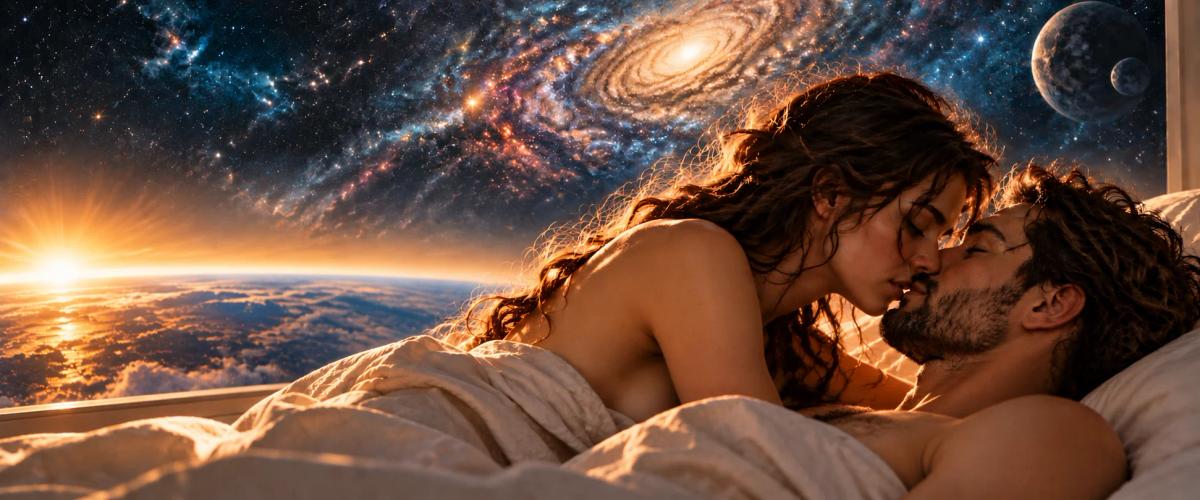
There is a moment in Interstellar that has always haunted me.
Dr. Amelia Brand is trying to explain something that sounds irrational.
Something unscientific.
Something almost embarrassing to say aloud in a room full of equations.
Love.
She says:
“Love is the one thing we're capable of perceiving that transcends dimensions of time and space.”
It is a beautiful line.
But it also contains a rather dangerous idea.
What if love is not simply something our brains invented?
What if it is something we discovered?
Science has a perfectly reasonable explanation for love.
We are social animals.
Attachment helps parents care for children. Pair bonding helps partners cooperate. Intimacy creates stable groups. Our brains reward connection with delicious little cocktails of dopamine, oxytocin, serotonin and all the other chemical accomplices of attraction and attachment.
None of this makes love less beautiful.
But it does raise an interesting question.
Does explaining what happens inside the brain explain what love actually is?
When you kiss someone you adore, electrical signals race through your nervous system.
Hormones surge.
Heart rate changes.
Pupils dilate.
Certain areas of the brain become very enthusiastic indeed.
Science can observe all of this.
But imagine describing your favourite song entirely in terms of vibrations in the air.
Technically accurate.
And somehow completely inadequate.
Perhaps the biology of love works the same way.
Maybe the brain doesn't create love any more than a radio creates the song coming through its speakers.
Maybe the brain is how we receive it.
That is where Interstellar becomes so fascinating.
The movie doesn't prove that love is a force of nature.
It simply dares to ask the question.
Gravity crosses enormous distances.
Light crosses space.
Time bends.
Matter interacts through forces we cannot see but whose effects surround us everywhere.
So Amelia wonders whether love might belong, somehow, to that mysterious family of things that connect us across distance and time.
Think about how strange love already is.
You can love someone who isn't in the room.
You can love someone you haven't seen in years.
You can love someone who has died.
Their body is gone.
Their voice is silent.
And yet the love remains.
Twenty years can pass and one photograph can suddenly collapse time.
You are there again.
Their hand in yours.
Their smell.
Their laugh.
The exact way they looked at you.
Whatever love is, it seems remarkably uninterested in behaving like an ordinary physical object.
And then Christianity makes an astonishing claim.
Not merely that God loves.
Not merely that God is loving.
God is love.
Love, in the Christian imagination, is not something humanity invented.
It existed before us.
Before our lovers.
Before our parents.
Before the first human heart ever fluttered nervously because somebody beautiful walked into the room.
Love was already there.
Which means that when we love another person, we are not creating something from nothing.
We are participating in something older than ourselves.
Drawing from it.
Passing it between us.
Becoming conduits for it.
Like lowering a bucket into a well that has no bottom.
And this is where science and faith become unexpectedly good dinner companions.
They are not saying the same thing.
Science can explore the mechanisms of attachment.
Christianity speaks about the source and meaning of love.
Those are very different questions.
But perhaps they don't have to be enemies.
Because discovering the biological machinery of love does not necessarily reduce love to machinery.
Knowing exactly which neurons fire when your wife kisses your neck does not explain why her kiss matters more than anybody else's.
Knowing that oxytocin participates in attachment does not explain why one person can become home.
Knowing the evolutionary benefits of pair bonding does not explain why human beings write poems, cross oceans, forgive terrible mistakes, sit beside hospital beds, make impossible sacrifices, or reach instinctively across the sheets in the middle of the night just to make sure the person they love is still there.
Mechanism is not meaning.
And perhaps this is where love becomes most interesting.
Not in churches.
Not in laboratories.
Not among physicists arguing about spacetime.
But in the bedroom.
Because love has always had a wonderfully inconvenient habit of becoming physical.
It wants hands.
Mouths.
Skin.
Warmth.
It wants someone brushing your hair away from your face.
It wants laughter beneath blankets.
It wants fingertips tracing familiar curves.
It wants the sleepy kiss before work.
The hungry kiss after too much time apart.
The quiet moment afterwards when two naked people stop trying to impress each other and simply lie there, breathing together.
If love truly is something larger than us, this may be one of the ways it enters the world.
Through bodies.
Through touch.
Through intimacy.
Through the astonishing vulnerability of allowing another human being to know you completely and saying:
Stay.
Maybe love doesn't become less sacred because biology is involved.
Maybe biology is precisely how the sacred becomes tangible.
A chemical reaction doesn't cheapen the kiss.
A nervous system doesn't cheapen desire.
Hormones don't cheapen devotion.
They simply give something invisible somewhere to live.
And maybe that is why loving someone deeply can occasionally feel almost religious.
Not because your partner becomes your god.
But because loving them gives you a glimpse of something larger than either of you.
Something you cannot own.
Something you cannot fully explain.
Something you can only experience.
For one strange little lifetime.
Perhaps Amelia Brand was wrong.
Perhaps love is entirely the product of evolutionary biology, an extraordinarily sophisticated trick developed by social mammals trying to survive.
It is possible.
But perhaps she was asking the right question.
Because when you have truly loved another person, there are moments when the explanation feels somehow too small.
When she is sleeping beside you.
When his fingers find yours without thinking.
When decades disappear inside a kiss.
When somebody knows the worst parts of you and moves closer instead of away.
In those moments, love feels less like something happening inside us.
And more like something moving through us.
Something ancient.
Something immense.
Something we did not create.
Maybe the extraordinary thing about love isn't that human beings invented it.
Maybe the extraordinary thing is that, for a little while—
we get to carry it.